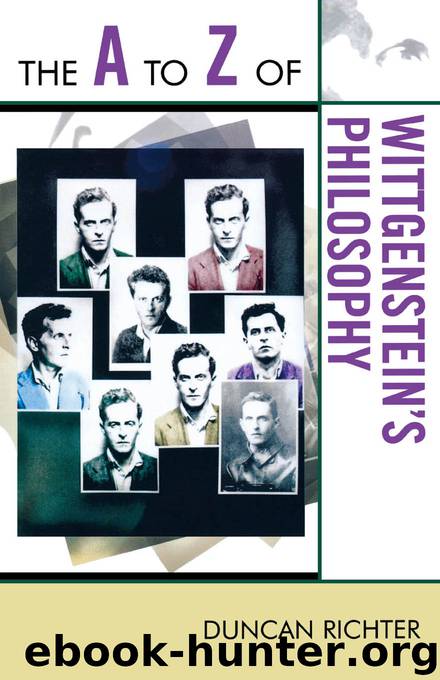
The A to Z of Wittgenstein's Philosophy by Duncan Richter
Author:Duncan Richter
Language: eng
Format: epub
Publisher: Scarecrow Press
Published: 2004-03-14T16:00:00+00:00
-M-
MALCOLM, NORMAN ADRIAN (1911-1990). A friend and student of Wittgenstein’s who became a well-known philosopher in his own right, working mostly on the philosophy of mind and epistemology. Malcolm taught for many years at Cornell University and was one of the main routes through which Wittgenstein’s ideas entered the United States. His books include Dreaming (1959), Ludwig Wittgenstein, A Memoir (1962), and Nothing is Hidden (1986).
MANCHESTER. When Wittgenstein was 19 years old, in 1908, he went to Manchester, England to study aeronautics. He first worked at the Kite Flying Upper Atmosphere Station near Glossop, where he designed and built kites. During this time he lived at the Grouse Inn on the Derbyshire moors. There he met William Eccles, an engineer who became a good friend of Wittgenstein’s. It was a letter from Eccles in 1925 that persuaded Wittgenstein to return to England for the first time after World War I.
In the fall he registered with the Engineering Department of Manchester University as a research student. It was then that he became interested in pure mathematics and the philosophy of mathematics, especially as discussed by Bertrand Russell in The Principles of Mathematics. He left Manchester in 1911 to pursue his interest in philosophy, having devised an impractical plan for an aircraft engine (which was later adapted successfully for use in helicopters) and patented a design for propellers.
MARGARETE. See WITTGENSTEIN FAMILY, THE.
MARXISM. Wittgenstein’s conservatism with regard to ethics and his taste in music did not extend to politics. Between 1922 and 1937 he was interested in going to the Soviet Union to live and work there, possibly with Francis Skinner. After an exploratory trip to Russia Wittgenstein gave up this plan, but for a while he believed that there was something good happening there. He did not believe in the theory of Marxism, but did believe in rejecting material greed and consumerism. He also opposed fascism and sympathized with the left’s concerns about unemployment.
MATHEMATICS. Despite leaving the subject for philosophy, Wittgenstein seems never to have lost his interest in mathematics. What he wrote on the philosophy of this subject reflects what he writes elsewhere about rule-following and related issues. Some of the work published as Remarks on the Foundations of Mathematics was originally intended to be a part two to the Philosophical Investigations. In these works Wittgenstein rejects Platonism, the logicism of Bertrand Russell and Gottlob Frege, empiricist accounts of mathematical truth as derived from experience, and formalism.
Instead of logicism and empiricism Wittgenstein resists reductionism of any kind and presents mathematics as a kind, or region, of language, with its own ‘grammatical’ rules. Thus what one might think of as mathematical truths are not so much facts as something more like norms. If one puts first two stones and then two more into a bucket and counts five in total, one does not consider revising the belief that 2 + 2 = 4. Instead one would assume that the bucket must already have contained a stone, or that one stone had broken in two, or something like this.
Download
This site does not store any files on its server. We only index and link to content provided by other sites. Please contact the content providers to delete copyright contents if any and email us, we'll remove relevant links or contents immediately.
Hit Refresh by Satya Nadella(9141)
When Breath Becomes Air by Paul Kalanithi(8451)
The Girl Without a Voice by Casey Watson(7892)
A Court of Wings and Ruin by Sarah J. Maas(7857)
Do No Harm Stories of Life, Death and Brain Surgery by Henry Marsh(6945)
Shoe Dog by Phil Knight(5274)
The Rules Do Not Apply by Ariel Levy(4974)
A Higher Loyalty: Truth, Lies, and Leadership by James Comey(4966)
Hunger by Roxane Gay(4931)
Tuesdays with Morrie by Mitch Albom(4790)
Everything Happens for a Reason by Kate Bowler(4746)
The Immortal Life of Henrietta Lacks by Rebecca Skloot(4593)
Millionaire: The Philanderer, Gambler, and Duelist Who Invented Modern Finance by Janet Gleeson(4482)
How to Change Your Mind by Michael Pollan(4360)
All Creatures Great and Small by James Herriot(4329)
The Money Culture by Michael Lewis(4212)
Man and His Symbols by Carl Gustav Jung(4140)
Elon Musk by Ashlee Vance(4130)
Tokyo Vice: An American Reporter on the Police Beat in Japan by Jake Adelstein(3998)
